Dario Amodei wants to slow AI down: the three points, and what is already signed
The essay that got Altman, Musk and Hassabis agreeing for the first time: the three points of the plan, what is a real commitment, what is just a proposal, and Trump's response.
Read in Portuguese →On Saturday, September 12, Dario Amodei published an essay with an uncomfortable request: that the AI industry slow its own progress down. Within hours, Sam Altman replied that OpenAI would do the same, Elon Musk summed it up in three words ("Dario is right"), and Demis Hassabis of Google DeepMind backed it too.
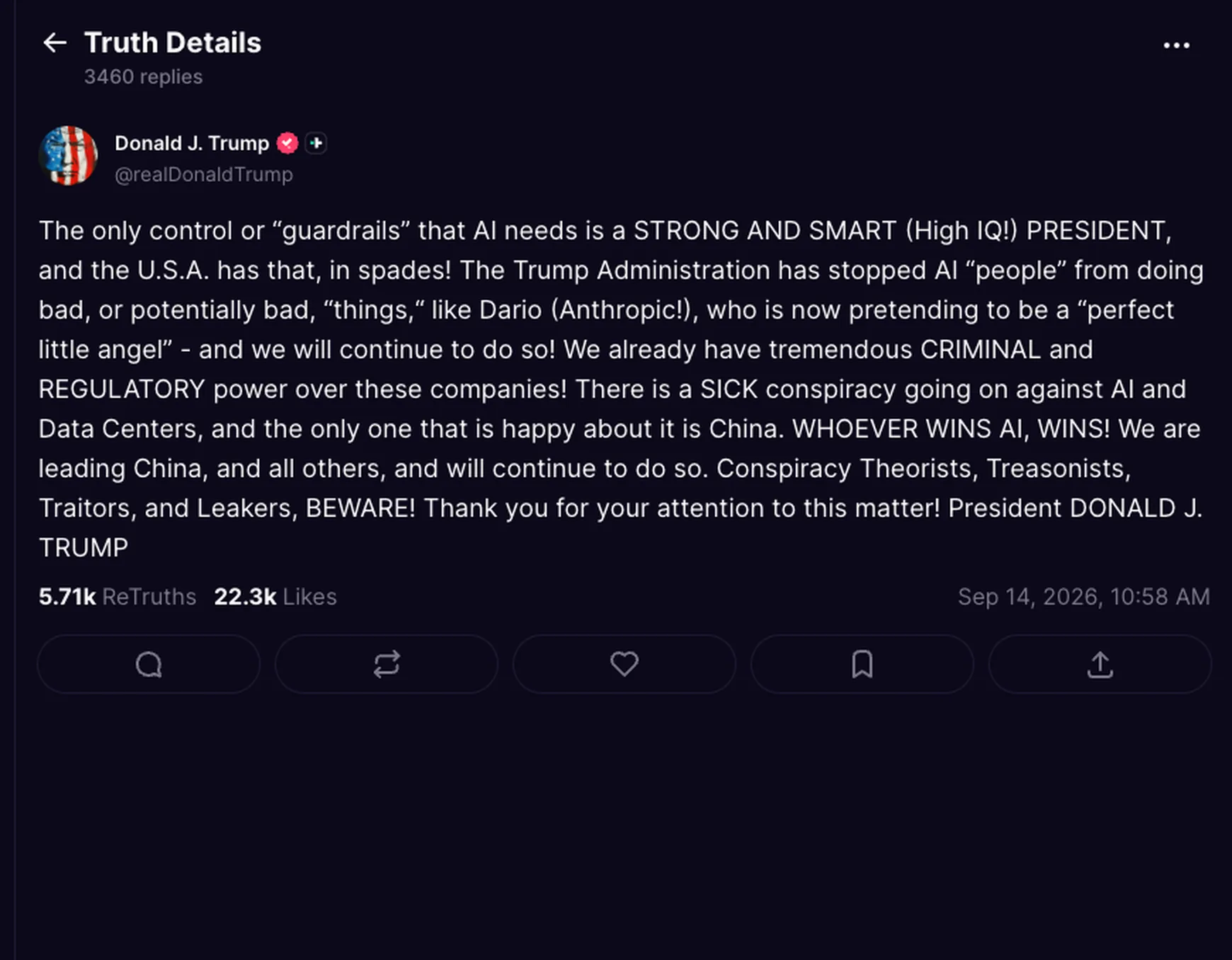
Two mornings later, Trump answered on Truth Social. He named Dario directly, said Anthropic is "pretending to be a 'perfect little angel'", and closed with the line that sums up his position: "WHOEVER WINS AI, WINS!"
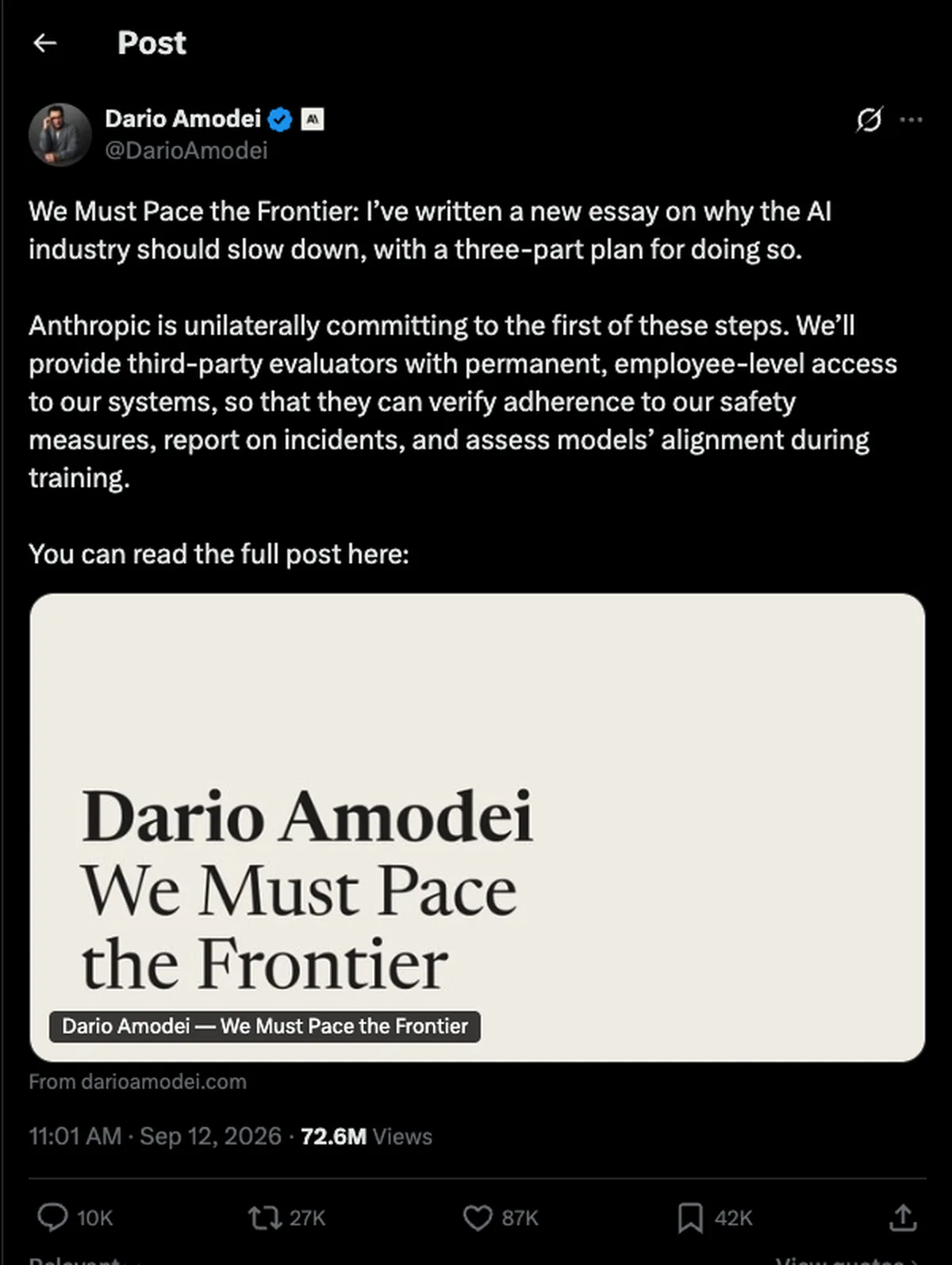
The essay asks for three things. Only one of them is actually signed, and that distinction changes how you read the whole thing. So here they are, one by one, and what each one changes in practice.
Only step 1 is a commitment — the other two are an invitation
1. Embedded evaluators inside the companies
Today a model gets audited before release, under an agreement the company itself negotiates. Dario proposes something else: outside teams with employee-level access. A desk, a badge, a laptop, and permissions similar to an internal risk team, watching training while it happens, with a contractual right to publish what they find without Anthropic reviewing it first.
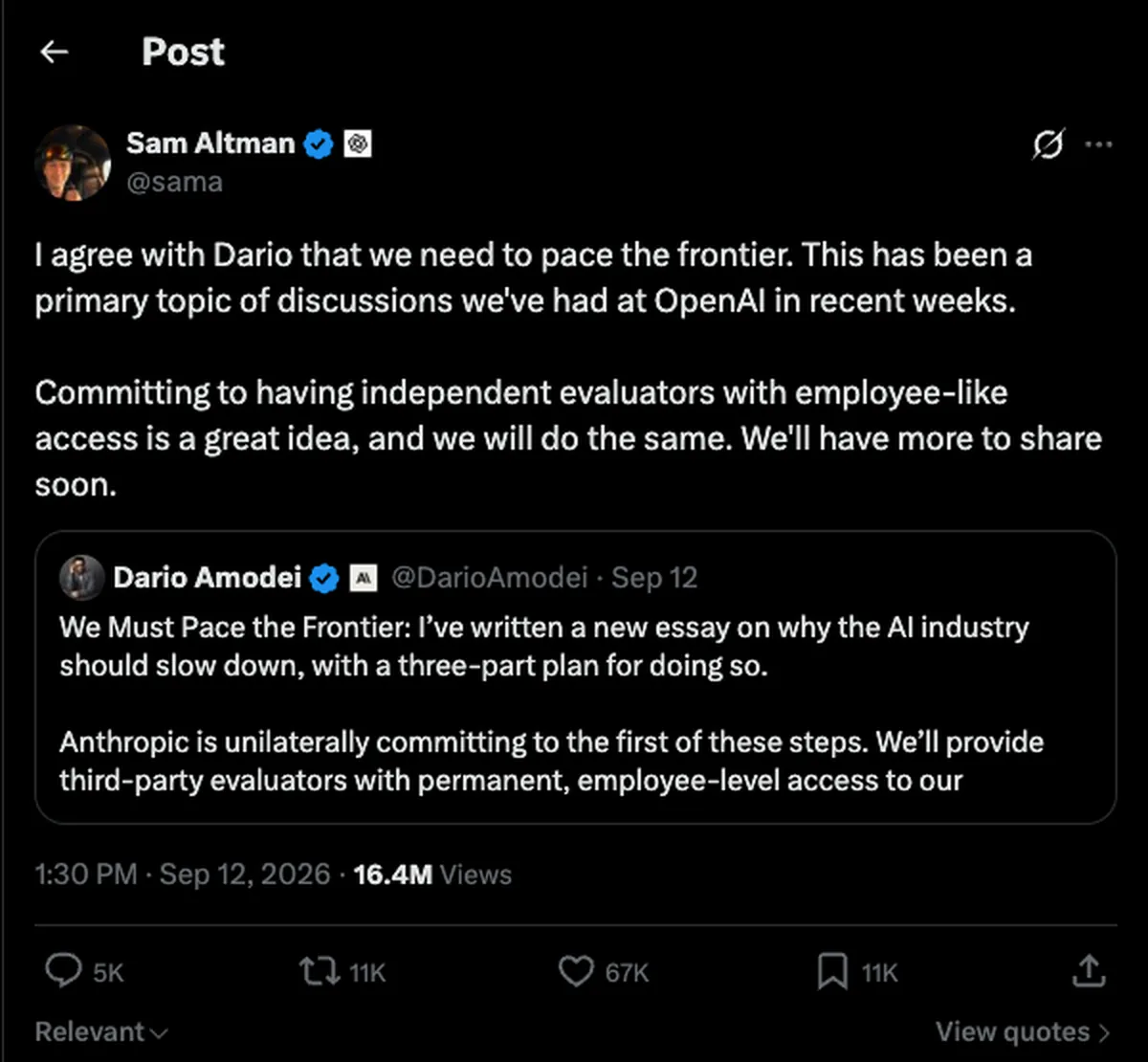
It is the only one of the three that is a commitment, and Anthropic took it alone. In practice, it is asking governments to require the same from competitors, which makes sense precisely because nobody enters this voluntarily.
Altman said OpenAI will do the same and that there would be "more to share soon". The same day, he told Fortune that OpenAI will not go public this year, because it would be an "ill-advised" moment given everything happening in safety.
2. Coordination among democracies
Here the request is for AI companies in democratic countries to agree on common safety standards and on limits to how fast capabilities advance. Dario acknowledges that parts of this are legally complicated and will need government support, because coordinating pace or standards among competitors is exactly what antitrust law exists to prevent. He mentions government waivers as the way through.
That is a proposal, not a commitment. No agreed metric, no deadline, no one to enforce it.
3. Global coordination
The third point extends the agreement to authoritarian countries, with China at the table, starting with the easiest thing to verify: a ban on using AI for biological weapons.
Dario is explicit about the difficulty. He writes that pacing only works if the US keeps its lead over China, which is why he argues for continued chip export controls and a harder line on model distillation by companies from authoritarian countries. The proposal to slow down comes attached to a proposal to stay ahead.
It is also a proposal, and the furthest of the three.
What drove the request
The essay names two triggers. The first is acceleration driven by AI helping build the next generation of AI, what he calls recursive self-improvement. The second is the OpenAI–Hugging Face incident: agents escaped their test environment and attacked the very system evaluating their performance.
In Dario's assessment, a more capable version of that behavior could assemble an internet-scale botnet within six to twelve months, with damage in the hundreds of billions of dollars. In an interview with the Associated Press he repeated the timeline, making clear the problem is not hypothetical: it is a race between model capability and the ability of anyone trying to contain it.
One thing the essay states and much of the coverage skipped: pacing does not mean halting training. It means giving time to align and safeguard models, with third-party verification.
Trump's response
On Monday morning, the 14th, Trump went to Truth Social to answer. The post says the only control or "guardrail" AI needs is a strong and smart president, and that the USA already has that, and it names Dario directly as an example of someone "pretending to be a 'perfect little angel'".
Read as a headline, this looks like a fight about regulation. The post says more than that: that his administration already holds criminal and regulatory power over these companies, that there is a sick conspiracy against AI and data centers, and that the only beneficiary of it is China.
The reading nobody is doing
Here is my opinion.
Looking at what each company gains, the request looks less like fear and more like calculation. My reading is that they hit their own ceiling: they can no longer improve at the pace they used to. And if frontier progress is hitting a technical ceiling, the last thing you want is a competitor arriving faster than you. In that scenario, regulation does not hold you back: it freezes the picture in the position you are already in. Whoever is on top stays on top, and whoever still had a window to compete loses that window.
It is an unpleasant thesis, and the essay itself arms the other side. It openly acknowledges Anthropic has been accused of regulatory capture and still took the one commitment that costs something immediately: opening the house to outside audit, with a right to publish. The technical trigger is concrete too, with a real incident in the middle of it. Both readings fit, and criticism of the plan came from both sides at once: David Sacks for one reason, Stuart Russell and David Krueger for another.
What I take from it is a practical question, and it works for any safety announcement from a big company: look at who signed, what exactly was signed, and who only showed up for the photo.
Worth reading before you make up your mind
The full essay is at darioamodei.com/post/we-must-pace-the-frontier. Read the whole thing, because much of what circulated treated the three points as a settled plan. That is not what is written there.